Thursday, September 8, 2011

Andrew Jackson by Robert V. Remini


#7.  Andrew Jackson, by far the coolest President I’ve read about so far.  Sure some would say he had a few issues politically and he clearly cared little for decorum, but those, plus his character, helped make Robert V. Remini’s booking exceedingly entertaining.   Seriously, it was cool.  Jackson is cool.  The book focused mostly on the subject’s battlefield accomplishments, which were by all accounts incredible.   It was bibliographical in that it did take the reader through all segments of Jackson’s life, but the greatest level of detail was dedicated to his feats as a war hero.   I really enjoyed it, which I credit Remini for as he seemed to give all the details that made the stories of the various battles entertaining without bogging me down with too much…after reading this book I wanted to see a movie, or 3, about Andrew Jackson.  

MR. Lynn Hudson Parson’s book about President #6, which I just posted about, had a great story of a victory party thrown by John Q.A., after the 1824 election, which was filled with well-wishers and hangers-on gleefully celebrating JQA’s upcoming Presidency.   One of the running jokes leading up to the party was ‘what would the uber war hero’s reaction be, considering that he had received more popular and electoral votes and then basically lost The Presidency due to some finagling by Adams and Clay.’   He hadn’t earned the nickname “Old Hickory” for being soft.   Well, of course, Andrew Jackson showed up at the party unexpectedly resulting in the ball room going quiet in a progression from entry to the very back where President elect, John Quincy Adams, was chatting it up as the victor that he was…facing away from the rest of the room, as the story goes, he became basically the last one to know who had walked in and was approaching him.   Wondering what was causing all the discontinuation of commotion he turned to see “Old Hickory” as the room went silent.   Andrew Jackson stood staring at him stone faced for a significant beat or two, before finally breaking into a smile and extending his hand.   Cinema worthy.  How cool was Andrew Jackson?   Put it this way, Thomas Magnum’s archenemy Ivan wouldn’t have walked away from Andrew Jackson. **

So yeah, I was definitely looking forward to reading about him, but I can say that this book served to increase my appreciation for Jackson as a movie hero like figure.  While it only gave a brief summary of Old Hickory’s political career I, of course, learned a lot reading this book as well.   To the bullet point format we go:

  • Jackson is claimed by 3 states and 1 city in Northern Ireland.   Seriously. 
    • Tennesseans claim him as a son of TN based on the fact that he called it home during his fighting career.
    • South and North Carolina both claim he was born in their state due to the fact that Jackson’s mother spent time in both during the final days of her pregnancy and no one can definitively prove if the birth took place in his mother’s home or in his aunt’s.
    • Carrickfergus, N. IRE has a Centre to honor him as a decedent due to his parents having grown up there.  (This I didn’t learn from the book, but rather from Ms. Wendy Davis who also hails from ‘Carrick’ as it is more commonly called)
  • Wiped out America’s debt completely.   He may not be too impressed with us right now actually.
  • Spain basically gave us Florida.  
    • Jackson ran roughshod through the state devastating Indian tribes that threatened the U.S. allowing then President James Monroe to effectively state that Spain must cede the land to us or do something to prevent its inhabitants from being a threat to us.   This actually worked because no one wanted to mess with Jackson and his troops...well, and because the Spanish knew they really couldn't forcibly keep the land due to the fact that they had other more pressing problems in Europe at the time.  
  • Jackson executed 2 British subjects who were aiding the Indian tribes he was fighting…this caused great controversy, but Jackson was not one to worry about such things.
  • While a General he made a practice of allowing injured troops to ride his horse while he walked and stay in his tent while he slept outside.   He marched his Tennessee Volunteers relentlessly without complaint.
  • He survived small pox.
  • During the Revolutionary War young Andrew and his brother were captured.  Andrew was struck with a saber for refusing to shine the boots of his British captor.   He maintained a hatred of Brits for the rest of his life.
  • My favorite picture of Jackson:  http://tinyurl.com/3fn3zcy

So, my favorite President so far…the original American Hero who goes outside the accepted law to do what the emotional masses want...a perfect segue to Martin Van Buren, right?

** http://www.youtube.com/watch?v=T7vW1oEKP1k


Wednesday, September 7, 2011

John Quincy Adams by Lynn Hudson Parsons


Another less than imaginative book title, but accurately descriptive I suppose (I may have to lower my expectations with regard to creativity associated with this project…it is centered on factual history after all).   Now…about the book itself…hmmm…I’m a bit surprised at how influenced my mindset can be by authors and more specifically the level of skill I attribute to their writing based on how it flows for me.  I felt this book was written in a style that was a little blander than perhaps I was hoping for and I think that tainted my opinion of John Quincy Adams…or maybe he just wasn’t as intriguing as his predecessors.  I was really looking forward to reading about John Quincy Adams because the first 5 biographies gave good preview of some of the things he was involved in.  I was especially interested in learning more about his time overseas starting as a young man making the epic trip across The Atlantic with his dad.    I thought his life story would just be incredibly interesting and, well, sadly I think Lynn Hudson Parsons failed to romanticize his travel filled life of tremendous public exposure in a way that I would consider smooth. 

The book wasn’t bad and I didn’t notice any specific butchery of the English language (as you most probably do when reading this blog), I guess I just expected a bit more entertaining stories…but then, Parsons did mention that most considered John Q. Adams to be less than engaging more often than not, preferring to bury himself in study rather than socializing etc., so perhaps she didn’t have much to work with from a personality standpoint.   That stated; his accomplishments and experiences alone would seem simple to weave into a fascinating story, so the result being that the book was written in a stereotypical historian’s insipid manner was a bit of a disappointment to me.   Of course the subject was interesting enough that I’d give it an overall passing grade, if for no other reason than that I stayed sufficiently intrigued to finish it without too many hiccups/significant delays and was enlightened to many things.   So, without further ado…things that Idiot Bob learned while reading about President #6, John Quincy Adams – who I will refer to as JQA from this point forward…or “he” etc.:

  • George Washington called him “the most valuable of America’s officials abroad” and while that is unquestionably reflective of GW’s appreciation for his abilities the statement also be a result of the fact that JQA had to be one of the world’s most traveled non-mariners of his time.  
  • JQA became fluent in French and Dutch, conversant in Russian and German and of course had mastery of the English language that far exceeded most of his generation.  
    • As fascinated as I am with people who know multiple languages, I really should learn another one myself.
  • He kept a diary for 69 years.  
  • On request of Congress, he undertook a comprehensive study of weight and measure systems to help determine which standard the United States of America should follow.   The completed study, in report form, was acknowledged as an unequalled review of the subject matter, but did not put forth a suggestion as to which of the predominant measurement systems of the time, Metric or Imperial, should be adopted.   Laziness, reverse nepotism, or fear, lead to the general practice of conducting business using the imperial system to continue and carry the day as tradition.  It is John Quincy Adams fault that we don’t use the metric system.
  • He didn’t actually win the election preceding his Presidency.   Andrew Jackson won the popular and the electoral vote, but didn’t have the majority needed, so the House of Representatives gave JQA the Presidency.   Speaker of the House Henry Clay is said to have used his influence to secure the Presidency for J. Quincy A. in exchange for appointment as Adams’ Secretary of State, but also, because like seemingly many others in the highly educated minority, he hated Andrew Jackson.   Clay, no doubt, felt that was the way to become the next President of the “U. States” as many abbreviated the country at that time.  
    • The “corrupt bargain” with Clay was quite controversial.   I found that interesting as today I doubt we would even be fazed by it.
  • JQA was the second single term President ever, following in his Dad’s footsteps.  
  • He negotiated The Treaty of Ghent, which ended the War of 1812…in 1814, even though we continued fighting for a while longer because there was no email at the time.
  • After he left the Whitehouse he was a congressman for 17 years.   To put that in perspective, if the same thing took place today, George H.W. Bush would be a congressman right now and would die sometime this year after casting his vote against honoring soldiers from the Mexican-American War, which most of the House of Representatives were in favor of, but he was vehemently against.
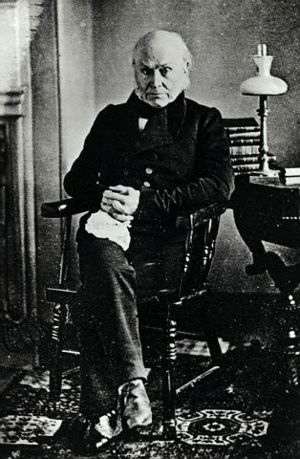
  • I think JQA’s greatest accomplishment may be that he became universally respected by his peers in that sort of “old dude is crazy, but he knows his stuff and is not someone to cross” kinda way.   His time as a sage crotchety old gruff and disagreeable congressman wearing the hat of “I don’t care about the politics of it, I’m on the side of what’s right!” is great to think about.   One look at any photo of him during his later years brings this thought easily to mind:  http://www.wikitree.com/photo.php/thumb/9/95/John_Q_Adams_1843_Photo.jpg/300px-John_Q_Adams_1843_Photo.jpg
  • There was a “Gag Rule” (http://tinyurl.com/Gagrule) in place preventing any petitions regarding slavery from being addressed by Congress.   JQA was the chief opponent of it.  Our country was on some shakey ground in its first century wasn't it?  Wow.
  • John Quincy A. made this statement, a poetic version of our Founding Fathers stance on participation in conflicts outside of U.S. borders or not directly involving the U.S.A, about the U. States which certainly makes one think how things have changed over the past 200 years:   “She is the well-wisher to freedom and independence of all.  She is the champion and vindicator only of her own.”      

Interestingly, probably only to me, I did NOT learn whether the writer was a male or female…not that it matters, but I did assume it would be easy to determine Parsons gender with a quick Google search, which it was not, marking the very first time I have ever found any justification whatsoever for an author to have his or her photo published – I only cared so I could write the first paragraph of this post using “his or her” when referring to the writer.   Despite that I couldn’t, I remain opposed to the idea of authors putting pictures of themselves on their books simply because from a marketing standpoint it seems counterproductive.  Speaking of photos; I have now gone back and added a picture for each Commander in Chief with each post and will continue to do so through the remainder of my quest.   Seems the office is not exactly a beauty contest.