Wednesday, August 24, 2011

The Last Founding Father: James Monroe and a Nations's Call to Greatness by Harlow Giles Unger


The best book so far.  I finished the book and couldn’t stop thinking about how under-appreciated James Monroe is.  He was indeed a great President and contributor to our history, but the book probably significantly helped me to come away with that belief.   Was it objective?  Nope.  Did it bother me that it wasn’t?  No, actually it didn’t at all…Unger made a hero out of Monroe, but there was enough there for it to be perfectly plausible that he was great in nearly every way, that I just enjoyed it.  The writing was solid, flowed well and resulted in a very fast entertaining read, especially for a biography.   I could go on, but I’d just be rephrasing the above words of praise for the book.  [Note:  If you have something against James Monroe then the book may infuriate you, but who has anything against James Monroe?  He rang in the “Era of Good Feelings!”]  OK, so, yeah, I also learned a ton reading the book…here are a few of those things:
  • He was shot in the shoulder during the Revolutionary War.  Unfortunately for him he was shot 141 years too soon (1776) to receive a Purple Heart, the coolest award that no one in their right mind ever wants to receive.  
  • Grew up friends with John Marshall, who basically created the judicial branch of our government, and remained friends with him throughout their lives even though they differed from time to time on policies etc.
  • Held 2 cabinet positions at the same time – Secretary of War and Secretary of State
  • Ran unopposed for the Presidency, twice!  (Well, basically…the first election he did have an opponent, but I think Mondale/Ferraro were closer to winning than his opposition)
    • He was one Electoral College vote away from being reelected unanimously for his second term.  It is said that the lone vote was cast for John Quincy Adams just so that George Washington would remain the only President elected by unanimous decision.  
  • All of South America owes him for the Monroe Doctrine…and so do U.S. West coasters.
  • Monrovia, Liberia is named after him.
  • The first wedding in the White House united two cousins in marriage.  (Maria Hester Monroe and her cousin Samuel Gouvereur)
  • George Washington gave him a letter of recommendation that Monroe hoped would help him become a Captain in the Continental Army, it didn’t, but James ended up using it to advance his political career.
  • James Monroe actually made the Louisiana Purchase deal – Jefferson gets credit as the President who ultimately authorized it, Madison gets credit as the Secretary of State who also authorized it and may have proposed it, but Monroe actually made the deal while overseas as our Minister to France, so he did the actual negotiation, which earns him the most credit for the fantastic bargain, if not any commissions.
  • After being elected President Monroe went on a tour of the country that would be exhausting even today in a Honda Odyssey with every possible amenity and 38 cup holders, in an effort to unify the people.  It worked as he was beloved by nearly everyone.  (Are you questioning the objectivity of the writer yet?  Count me convinced, he’s my new Favorite Founding father, after THE Founding Father {George Washington}, of course.)
  • James Monroe Died on July 4, 1831.   Are you kidding me?!   3 of the first 5?!!  And GW died on Case’s birthday!  Madison (June 28, 1836) couldn’t hold out 6 more days?  Or 5 months and 16 days?  Man…I am not impressed Mr. Madison.
OK, sorry for length of this one, but to me it is fitting since it was my favorite book thus far (plus these will get longer if I ever get caught up to the book I’ve just finished…still half a year or so behind, so be prepared).   John Quincy Adams coming soon…

Friday, August 19, 2011

The Great Little Madison by Jean Fritz


The first snag!   Accomplishing completion of book #4 proved to be a bit more difficult than 1-3...I bought "James Madison" by Ralph Ketcham and made it through 148 pages.   Those pages took me maybe half a year to read.   I seriously questioned whether I would ever finish the project....I still question it, but at least a little less than at that point.   I actually liked the book and there is no doubting that Ketcham did an exhaustive research effort before writing it...it's just that it was like eating tasty corn bread after leaving an all you can Tuesday night at Waffle House.   6 pages into the book and I had read more about the Madison family PRE-James than I have read about any family ever.   It was quite an amazing family, having spawned 2 U.S. Presidents (#4 and his second cousin, #12, Zachary Taylor), but that turned out to be indicative of the rest of the completely thorough review of James Madison's life.   I wouldn't say that it was boring, because it wasn't, it was just more than I was apparently looking for...so, I called an audible (and I do hope to finish the book someday, ya know, cus I ain't no quitter, and it was written pretty well, but as it threatened to derail the entire project I felt it best to move on) and found another James Madison book...well, that one turned out to be a 20 page kids level book, which would have made me upset with my Kindle, except that since it was only 99 cents I realized that I should've probably known something was up....SO, then I bought another James Madison book -- seems I spend money like our Founding Fathers, but anyway, this one was finally what I would consider good enough.   "The Great Little Madison" was only a few hundred pages long and kind of painted with a big brush, but having endured the 148 super detailed Ketcham pages and the wiki-plus sub-$1 attempt to satisfy "book #4 requirement" I was pleased with it.  Ralph Ketcham's book haunts me as it sits on the bookshelf, being nearly 800 pages long and therefore more visible than most, but I'll get to it someday so I guess I won't throw it on the fire...yet.   OK, so, let's just skip straight to the bullet points from here...The James Madison book list of things stupid Bobby learned:

  • James Madison seriously wrote the Constitution of the United States of America.   I guess I figured it was maybe 50 people or something, and in a way I guess you could say it was even more than that, but he seriously wrote the thing.  It is amazing and I give him full credit.  
    • He apparently studied all known attempts at formulation and experience of governments throughout the history of the world and used that incredible base to help achieve the tremendous accomplishment.   He then, being a scribe like perhaps no other person in public service before him, proceeded to team with Alexander Hamilton and John Jay to explain The Constitution to the people and defend it expertly through the press.  Their efforts are called "The Federalist Papers" and I feel like I should probably stop the project and read them in their entirety before moving on, but, well, that's not gunna happen.  As a result of his efforts in writing The Constitution, explaining it in writing and defending it through his life, he was, well, the greatest defender of it in the country's history.   This fact makes me think that he'd probably be the best U.S. citizen to bring back to life if we ever had that power, but I'd probably still choose Len Bias (1963-1986) or Tiger Woods (1975-2009).
  • Madison regularly made himself ill foregoing sleep and general health maintenance just to study/read/write.
  • Aaron Burr introduced Madison to Dolly, who became Dolly Madison the hardest partying 1st lady in history (to that point she unquestionably was, I'll let you know if she loses the title).
  • The Alien and Sedition Acts...just read about them, bizarre.  We really could've been like all the countries we think are insane.
  • During his Presidency his two VP's died while in office.   Remind me not to mess with James Madison if I ever travel back in time.   
  • The War of 1812 really was pretty questionable.
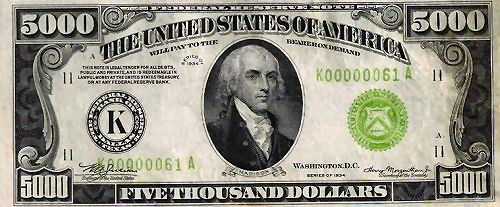
  • Madison is on the $5000 bill.  I've never seen a $5000 bill.   I'd like to.   It would look like this:  http://www.marshu.com/articles/images-website/articles/presidents-on-us-paper-money/five-thousand-5000-dollar-bill.jpg  (I actually didn't learn this from the book, but since I'm now interested in Presidents I seem to learn all kinda stuff about them just through everyday life....Madison Square Garden for instance, named after good ol' quatro!)
And I march on to Mr. Monroe...

Thursday, August 18, 2011

American Sphinx: The Character of Thomas Jefferson by Joseph J. Ellis


Believe it or not I actually purchased and read this entire book before realizing that it was written by the same guy who wrote the George Washington book I liked.  Not surprisingly then, I liked this book as well -- Ellis seemed to go out of his way to be objective, to the point of thoroughly presenting both sides of controversial viewpoints in regard to Mr. Jefferson, the 3rd President of the U.S. of A.   Yes, I was surprised that there were varying viewpoints on Thomas Jefferson as a whole, but we'll get into that in a bit...gotta stay on task here, reviewing the book.   The writing was detailed without being overdone and I believe the authors apparent goal, to outline and explain the former Presidents character, was accomplished...I definitely felt that I had been given insight towards him as a man, more-so than having been given a framework of his life accomplishments, of which there are, of course, many.  At times I did feel like JJ Ellis may have bordered on attacking his character actually, but as biographies tend towards the flowery and apologetic in relation to the subject I welcomed the counter points and he did also write of the positive as well, which again points to the objectivity of the book.   The length of the book was close to if not perfectly ideal.   Alright, now, to what I learned:

  • The Declaration of Independence that he is credited for writing, was not exactly written from scratch.  It was more a reorganization of previously written documents (1689 English rights document and the Constitution of Virginia, etc. etc.), with a distinct unification of sentiment angle -- he deserves great credit for the effort, no doubt, but I guess I always though he just sat down one day and wrote it from his own thoughts and viola, it was what some consider the greatest document ever created.  I realize now that my thoughts were incredibly unrealistic, but then, I never really thought about it.
    • States had their own Constitutions.
    • The topic/issue of slavery was discussed during the framing of the Declaration of Independence and purposely side stepped...this completely shocked me as I didn't think it was on anyone's radar until Lincoln decided slavery just wasn't right -- yes, I am that ignorant, or rather I was.  
  • Jefferson was not a good money manager.  He didn't seem to understand the concept of spending only what he actually had.
  • Alexander Hamilton was quite a figure in history...if I ever finish this project I'd really like to read a biography or 2 about him.   Jefferson didn't like him at all, but I guess probably liked him more than his VP, Aaron Burr, did.  
  • Thomas Jefferson commissioned the very cool and very bold Lewis and Clark Expedition...I had no idea at all when L & C went on their journey nor any of the reasons they did, prior to reading this book anyway.
  • The Louisiana Purchase was completed during TJ's presidency.
    • It did not include the Southwest...my head was seriously spinning learning that as I really did think it was everything west of the Mississippi.   I did very well in every history class I took too, seriously, I did.
  • The Secretary of State is in charge of foreign policy.  I find it amazing that I enjoyed as many Ludlum, Flynn, Clancy etc. books and similarly themed movies as I did without being aware of that.   It was also a monstrously important political position in the first era of our country having been a pathway to the Presidency for Jefferson and then 4 other of the first 9 Presidents.  (I'll let you know when I think an "era" begins and ends in relation to our country...right now I'm thinking Pre-Civil War is Era 1, but I may amend that as I learn more)
  • Party related "politics" have been a part of our history since George Washington left public service.
  • Thomas was portrayed convincingly as a conniving, manipulative person who, while being perhaps naively and inspiringly optimistic about the country and its people's lot in life, was basically dishonest in some instances.   For this reason I do not think that the typical UVA graduate would appreciate this book very much.
  • I want to visit Monticello.
  • The French Revolution was literally RIGHT AFTER ours.
  • Jefferson's mentoring type relationship with Madison and Monroe was pretty incredible.
  • He died on the same day, the 50th anniversary of July 4th 1776, as John Adams, his friend/peer/enemy/friend/peer/enemy/friend.

OK, I'm pretty sure I learned more than just those points actually, as again Ellis seemed to write in a style that I found easy to read, but it's been a while since I finished the book, so I have probably now forgotten everything else I learned...I might have to do this project again...I was eager to read about James Madison next though...and with that, I'll end this post.

Wednesday, August 17, 2011

John Adams by David McCullough


OK, so, Pres book #2...well, this one won a Pulitzer, so not sure what I could say about it that hasn't already been documented by many others with better mastery of the English language and probably more time as well, but hey, this is my blog, so I'll ramble on for a bit anyway.

It was a well written, very detailed, but not extremely heavy read -- well, I borrowed the hardback from someone, so it did actually weigh a lot, but the content flowed pretty well.   Some things were more detailed than perhaps I cared to read about, namely the endless elaboration about Mrs. Adam's (pretty amazing lady it turns out) home decorations and personal attire, but even those were framed in a manner that at least painted a picture so to speak.   I learned a great deal about the time period by reading the book and that may end up being my greatest fascination with this project, just learning a bit about how things were.   McCullough did a solid job in his attempt to be objective, in that even though it was apparent that he thinks highly of John Adams and all of his accomplishments, he also made it clear that our second President had his shortcomings as well.  So, overall summary...good book, I would've preferred if it had been say 400 pages instead of 700+-, but having made it through the 700 confirms that it had to have been a pretty good book to read.  I was eager to read the next book after finishing this one, which is a testament....now, what did I learn?   Well, let's stick with the "comments about the book and then list things I learned" format as that seems easiest...so, here's the John Adams book list of things stupid Bobby learned:

  • John Adams represented the British Soldiers, successfully, in the Boston Massacre.  I found that truly amazing and shocking that I didn't know that before, or at least didn't remember it...throughout his life he managed to give the law profession a good name, confirming that, well, some things do change...and drastically.   
  • Our founding Fathers were very serious about how they would be viewed by future generations etc.; Adams was borderline obsessive with his documentation for sake of posterity.   
  • Spending government money freely, without concern for sustainability is not new to our generation -- The Adams Family, minus Lurch, felt fully justified living like kings overseas on Uncle Sam's dime, though at least that's all they did as opposed to flat out stealing.   Gotta credit our founding Fathers for being honest in that regard as well, as by all accounts they were.
  • It took a long time to get across the Atlantic back then...and it was insanely dangerous, I truly had no idea.  It was additionally amazing to me that as a new country we sent envoys to Europe with regularity, even though communicating with them was at best a seemingly hopelessly delayed process.   
  • That generation had more spare time than we do -- sure that may just seem like 21st Century whining...or would that be Weining?...but I honestly don't see how it can be seen any other way...when Congress wasn't in session the leaders went and lived completely different lives....when major decisions needed to be made everyone stopped what they were doing and just hashed it out until completed, no harm done to any markets etc. while they did.   Decisions could wait on news from Europe that would arrive, MAYBE, within the next few months.  Taking weeks or months off was basically of no consequence and at no time did anyone think less of another for doing it.   Everyone seemed to have had time to read and write at great length.  
  • We actually owe a lot to Holland/The Netherlands -- turns out, on Adams request, they lent the U.S.A. money that was vital to our survival as a young country at war.   Reading this made me hate the 2 guys I know from there a little bit less...a little bit.  (I like the country and the people, it's just the two I know best I don't like at all...it's work related, trust me, it's not interesting at all).
  • He died on the 50th anniversary of July 4th celebration...in his correspondence he seemed to just want to make it to that date before passing.   
  • Philadelphia, PA was effectively the Nations 1st Capital, as the home of what acted as the Capitol -- I may have learned that in the first book, but anyway, it was news to me.
  • JA was the 1st one term president
  • John was a very emotional guy -- he and Jefferson had an on again off again relationship that defies logic and seemed to exhaust them both over the course of their lives.  
  • The English thought of American's as beneath them...makes sense, considering the time, but that underlying mindset, plus the War(s), makes it amazing to me that we've come so far as to now consider each other allies without strings to speak of.   
  • John Adams despised Benjamin Franklin.

OK, that's all for book #2, hope to post something about book #3 pretty soon as I continue to try to catch up (still on Pres #10 as I write this)

Wednesday, August 3, 2011

His Excellency: George Washington by Joseph J. Ellis

George Washington.  The first President of the United States of America and therefore, the first biography I read in my quest.   I'd summarize this book as a great start.   George himself was as intriguing a character as he could possibly be, as one would expect after seeing that there are freakin zillions of books about him, but of course I had no idea just how intriguing because I had never read any of those books.   Thankfully I started with this one, so I don't feel I need to.  

The book was well written, I like Ellis, objective and informative without being text bookish -- I hammered through the book much more quickly than I thought I would and was further motivated to read about the subsequent 43 Presidents (or is it 42?  I don't know if Grover Cleveland is counted twice, or once...I have seen conflicting reports.  Sure this would be easy to find out with an on-line check, but I'm not sure that I want to know....I don't avoid learning things about Presidents I haven't yet read about -- I am currently on #10 -- but at the same time I'm somewhat fascinated by learning things in sequential order, so...don't tell me, unless you really feel like it).   GW really was the perfect choice to be President #1 and I'll say no more about him specifically as I wouldn't know where to begin or end, without researching and trying to write a book of my own...Ellis did a good job and I think anyone with any interest would enjoy his book.   That stated, of course I learned many things that were shocking to me...I'll list a few now:

  • Apparently he didn't have wooden teeth, or so says Ellis.  The cherry tree story also was not true, per Ellis.
  • George was a war hero before the Revolutionary War, but not really because he had a real impressive battle record...he didn't, but he wasn't scared, which gained him great respect -- he also wasn't very chatty and I think that gave him the stoic leader aura, which he capitalized on quite well.  
  • Martha had all the money, or rather her family did. 
  • He was a real frontiersman, having covered more ground than most as a land surveyor and then a soldier in the French and Indian War.  
  • The Vice President used to just be the Presidential candidate who received the second most votes....like right now we would have Obama as Pres and McCain as VP, which would be a bit odd wouldn't it?
  • Early American's didn't really know how to react to a President as their experience was either as subjects to King George (in England) or as kids visiting a place without parents (N. America).  Washington probably could've declared himself King and gotten away with it...well, it may have ended like Napoleon declaring himself Emperor, but whatever, it was all up in the air there for a while.  By all accounts good ole George (ours, not theirs) hit a 7 RBI home run choosing to step down as President when he did and regularly default to democratic views as opposed to monarchistic (that's not a word) practices.  Pretty amazing stuff.
  • Washington died on Case's birthday.


OK, that's all for now on GW and this book.