Wednesday, October 26, 2011

Old Tippecanoe: William Henry Harrison and his one month Presidency by Keith Norris


Old Tippecanoe!  Pres. Number 9.   Well, when researching biographies to read about him I already knew he had died in office a month after his inauguration and coming off the less than exhilarating Van Buren book I decided I would justify reading a short book about him.   Not the shortest I could find as there are actually a ton of different elementary school books about these guys ranging from 10-75 pages, but definitely not in the 350+ page range.   That landed me on Keith Norris’ book, “Goodbye Old Tippecanoe: William Henry Harrison and his one month Presidency.”   The reviews I read were positive and it said it was only 200 pages long, plus it was available on Kindle, so it won the first try.   To its credit, it was short and I’m just dumb enough to ride that through to the end of the book.   It just wasn’t written very well and actually the $4 Kindle version had some text arrangement issues as well, but having later learned that Norris is neither a professional writer nor a historian I guess it wasn’t really that bad an effort.   He clearly researched the subject and as a result Stupid Bobby did learn plenty of things…here are a few:

·         Old Tippecanoe, Harrison’s nickname resulting from his command of U.S. Troops during “The Battle of Tippecanoe” didn’t exactly lead a dominating victory that day.   The Native American’s did retreat, but only after they had killed more U.S. soldiers’ than they lost.  
o   His victory at “The Battle of Thames” in 1813, during the War of 1812, was decisive and resulted in the death of Tecumseh, who was the leader of the Native American’s he had fought against in “The Battle of Tippecanoe,” two years earlier, so he got a lot of credit and praise as a war hero that may have been jumbled a bit in the common voter’s minds.
·         William Henry Harrison (WHH) had ten children with his only wife.   Four of his five sons died prior to his own death, the other became the Father of the 23rd President of the U.S.A. (Benjamin Harrison).
·         Cincinnati was considered and called “the Northwest territory,” because it was.
·         WHH was a proponent of slavery, which made me think “Finally a President who doesn’t have a historian trying to convince me that he was actually against it, but politically had to support it,” as that has been the case for the previous 8, none-of-whom managed to do anything about their alleged personal distaste for the “peculiar institution” of selling people as it was referred to.
·         He ran for the Presidency for maybe the most honest reason anyone ever has.   He needed the money and the position paid well.
·         “Tippecanoe and Tyler too!” was the first widely embraced campaign slogan in U.S. history.   It helped spark a media storm campaign that took whatever wind was offered and sailed off rapidly with it.   Case in point, Harrison’s opposition characterized him as a dolt who would be contented to waste away in his log cabin drinking hard cider, only to see the Whig’s turn that into a grass roots 'poor hard working man of the people' movement regardless of the fact that WHH had been raised the wealthy son of a plantation owning Governor of Virginia.   Brilliant actually.   As part of the campaign log cabin shaped whiskey bottles were made by E.C. Booz distillery and became so popular that “Booz” became synonymous with…booze.   True story…now aren’t you glad you’re wasting your time reading this blog?  
·         He didn’t die of a cold, he was murdered.    OK, the book didn’t say that, but it did give compelling evidence, in the form of the medical record of the illness that started his downhill ride to the afterlife, which convinced me that
o   a) the doctors actually killed him and
o   b) Arsenic may have been involved.  
Yes, I like conspiracy theories, but considering the fact that Harrison got crosswise with Henry Clay, who no doubt thought himself to be infinitely superior to Old Tim and more fit to have been President (he ran for the office 5 freakin times), immediately after being sworn into office – to the point of forbidding Clay to visit The White House limiting their correspondence to written letters only – what better “Compromise” could there be other than to kill him off and possibly be given the Presidency himself?   If not that then perhaps Tyler took him down?   There is evidence of Tyler discussing the potential event of Harrison’s death prior to him falling ill, and he did act quickly and decisively once William H.H. kicked bucket.   So, back to the doctors killing him for a minute;   The following treatment methods were used on what all accounts considered a common cold:  bleeding, cupping, leaches, blistering, (these were all documented as intentional by-the-way) calomel, ipecac, camphor, (whatever those are) rhubarb and weak brandy (seriously, dude is dying and you water down his brandy?!  When was the Hippocratic Oath written?!).   The final notes in the medical log state “so worn out, nothing could save him.”   Shocker.   Anyway, so my personal theory is that Clay or Tyler and possibly both together, slipped some arsenic into their buddy William’s food, then sent in the 19th century Team Kevorkian to finish him off so they could get to work on their own agenda’s.   [If that is what happened then Tyler really did work over Clay didn’t he?   Sorry, I’m getting ahead of myself here]
·         As part of the pension Congress awarded to Anna, William Henry Harrisons wife, she was allowed to send mail postage free for the rest of her life.
·         Buried in North Bend, Ohio, atop a hill overlooking The Ohio River, tradition holds that vessel Captains blow their horn in tribute to Old Tippecanoe with every passing.   I very much want to witness this tradition someday as apparently it is still common practice.

A few noteworthy quotes to prove that he was well intentioned and leave us wondering what may have been had he survived the cold/torture that ended his life:
    • "The strongest of all governments is that which is most free."  -- Expressed to Simon Bolivar during his stint in Columbia.
    • "We admit of no government by divine right...The only ligitimate right to govern is an express grant of power from the governed." -- Quote from his inaugural address (sounding a bit like Jefferson I thought)
Additional/bonus point:    I am fascinated by the views expressed by the Presidents that surround each POTUS.   It is rare that they like or even respect their predecessors or the successors and thanks to my Great Mom I have a really cool book entitled "In the Words of the Presidents" by Ian Crofton which provides noteworthy quotes from each President as well as about each President.   I am now using this book as supplemental research material to enhance this blog...I am currently maintaining the decipline of reading the few pages of recap plus quotes from and about each President only after I have read a biography about the President in question -- it's quite enjoyable actually as it gives me a big picture recap and easy access to good material in the form of quotes.   That stated, let me now share a quote about William Henry I found somewhat comical, if not surprising, considering the quotee:
    • "Our present imbecile chief."  -- Andrew Jackson when asked about Harrison, apparently during his 30 day term.    So Jackson I simply have to appreciate it.  
    The book ended with a detailed history of the keeping of W. Henry Harrison's tomb (allowed to go into disrepair regularly due to funds shortages etc.), which was, well...a bit much considering it made up 15-20% of the book.   I understand the tomb is now in good shape, so I will spare you the minutia and leave you looking forward to John Tyler, or at least happy to be finished with the above -- Tyler is interesting, hopefully I can do a better job relaying that, we shall see...

Wednesday, October 19, 2011

Martin Van Buren by Ted Wider


OK, first let me apologize to you, the readers of this blog, all five of you.  I am sincerely sorry for having put the posting part of this project on hold for so long…I have no excuse, but I also doubt it has negatively affected anything in your lives, so that’s as much of an apology as I can muster…now back to my education:   OK, books 1-7 were easy enough to find and as you will recall from the Madison effort even bailing on the first book chosen caused no major issues since there were others to choose from…well, ol’ Ocho seems to be the point at which fewer options are available.   I expect this to be the case until perhaps Lincoln.  On the positive side, I now have library cards at four separate libraries and using them will reduce the cost to complete my little project, so I’ve got that goin for me…which is nice.   Alright, back to the subject:   The Martin Van Buren book.  Well, considering that it was the only option available, other than a $50 hardback listed on Amazon, I was pleased to discover that it wasn’t bad at all.   Perhaps a bit text bookish and lite on truly memorable stories…but then, that’s a pretty good description of the subject himself.   

The book kept my interest throughout and as the book progressed I became more and more amazed by Van Buren’s (MVB) political savvy.   The book credits him with organizing the democratic party resulting in it acting in the same manner as today’s political parties aspire to – all for one kinda stuff, giving a little to get the whole, party line, etc.   The author made an excellent reference to MVB’s ability to count votes and understanding how valuable that skill alone can be, making me think of how personally cunning our Presidents all had to be prior to recent times when some would argue that all they need to be are puppets for their party; the concept that Van B created, of course.   So, what did I learn from this book other than that?   Well, I knew he was the 8th President of the U.S.A. and he was from New York, because Seinfeld taught me that: http://www.youtube.com/watch?v=qkpnOTr8k9I , but what else?   To the bullets:

  • First American born U.S. President (previous 7 were all born British subjects)
  • Another former Secretary of State, which he was appointed to after having been elected Governor of NY only 2 months before – shortest term as Governor in NY history
  • He was a successful lawyer
  • Basically the first unapologetic professional politician
    • "His principles are all subordinate to his ambition" -- John Quincy Adams  (the book didn't really portray Van Buren as JQA's quote has, but I liked the quote and also find that I like Quincy Adams more and more as the sharp tongued bitter old bat that he became after his single term as President) 
  • There were Mormon Wars.   These can be summarized as deadly conflicts resulting from the eternal practice of prejudice against outsiders.   (A bunch of Mormon’s settled in Missouri and the Missourians already there didn’t like them, eventually expelling them from the state)  Could both sides be faulted, probably, but the simple fact that the Mormon Wars are part of our country’s history came as a shock to me since I thought that religious freedom, as we know it today, was one of the cornerstones of our foundation.   Seems it took a while to settle on exactly what definition of freedom would be used.
  • Had the greatest sideburns in U.S. Presidential history (see above)
  • "As to the presidency, the two happiest days of my life were those of my entrance upon the office and my surrender of it."  An excellent quote from Martin Van Buren alluding to his difficult term during which he was often criticized for the fact that the country went into depression almost immediately upon his inauguration.   Also little doubt that it spawned the similar phrase overused by nearly every boat owner since the first person to realize that water displacement makes objects float and profit could result from selling variations capitalizing on that fact.
  • Van Buren Street in downtown Phoenix, AZ was named for him (This didn’t occur to me, even though, as noted, Seinfeld had educated me to his presidency).
  • Earned $25,000 per year as POTUS (President of The United States), which he took in a single lump sum at the conclusion of his four year term.
  • The term “OK” was popularized as a result of Van Buren’s supporters, calling themselves the “OK Club,” using it during campaign efforts to accentuate the dual meaning of its use as an acronym* standing for “Old Kinderhook,” referring to MVB’s home town in NY and its literal meaning as an acronym* standing for “ol korrect,” an old English spelling of “all correct.”  
    • Acronyms* experienced a tremendous surge in the United States during the late 1830’s and 1840’s, somewhat similar to life in Singapore today.   Wonder if 150 years from now Singaporean movies will have characters like Leo Getz?   http://tinyurl.com/659f4kk
  • Martin was an interesting President, but not likely to be one of my favorites at completion of the project.

OK, so that’s enough for number 8, on to William Henry Harrisons half-bimestrial Presidency…

Thursday, September 8, 2011

Andrew Jackson by Robert V. Remini


#7.  Andrew Jackson, by far the coolest President I’ve read about so far.  Sure some would say he had a few issues politically and he clearly cared little for decorum, but those, plus his character, helped make Robert V. Remini’s booking exceedingly entertaining.   Seriously, it was cool.  Jackson is cool.  The book focused mostly on the subject’s battlefield accomplishments, which were by all accounts incredible.   It was bibliographical in that it did take the reader through all segments of Jackson’s life, but the greatest level of detail was dedicated to his feats as a war hero.   I really enjoyed it, which I credit Remini for as he seemed to give all the details that made the stories of the various battles entertaining without bogging me down with too much…after reading this book I wanted to see a movie, or 3, about Andrew Jackson.  

MR. Lynn Hudson Parson’s book about President #6, which I just posted about, had a great story of a victory party thrown by John Q.A., after the 1824 election, which was filled with well-wishers and hangers-on gleefully celebrating JQA’s upcoming Presidency.   One of the running jokes leading up to the party was ‘what would the uber war hero’s reaction be, considering that he had received more popular and electoral votes and then basically lost The Presidency due to some finagling by Adams and Clay.’   He hadn’t earned the nickname “Old Hickory” for being soft.   Well, of course, Andrew Jackson showed up at the party unexpectedly resulting in the ball room going quiet in a progression from entry to the very back where President elect, John Quincy Adams, was chatting it up as the victor that he was…facing away from the rest of the room, as the story goes, he became basically the last one to know who had walked in and was approaching him.   Wondering what was causing all the discontinuation of commotion he turned to see “Old Hickory” as the room went silent.   Andrew Jackson stood staring at him stone faced for a significant beat or two, before finally breaking into a smile and extending his hand.   Cinema worthy.  How cool was Andrew Jackson?   Put it this way, Thomas Magnum’s archenemy Ivan wouldn’t have walked away from Andrew Jackson. **

So yeah, I was definitely looking forward to reading about him, but I can say that this book served to increase my appreciation for Jackson as a movie hero like figure.  While it only gave a brief summary of Old Hickory’s political career I, of course, learned a lot reading this book as well.   To the bullet point format we go:

  • Jackson is claimed by 3 states and 1 city in Northern Ireland.   Seriously. 
    • Tennesseans claim him as a son of TN based on the fact that he called it home during his fighting career.
    • South and North Carolina both claim he was born in their state due to the fact that Jackson’s mother spent time in both during the final days of her pregnancy and no one can definitively prove if the birth took place in his mother’s home or in his aunt’s.
    • Carrickfergus, N. IRE has a Centre to honor him as a decedent due to his parents having grown up there.  (This I didn’t learn from the book, but rather from Ms. Wendy Davis who also hails from ‘Carrick’ as it is more commonly called)
  • Wiped out America’s debt completely.   He may not be too impressed with us right now actually.
  • Spain basically gave us Florida.  
    • Jackson ran roughshod through the state devastating Indian tribes that threatened the U.S. allowing then President James Monroe to effectively state that Spain must cede the land to us or do something to prevent its inhabitants from being a threat to us.   This actually worked because no one wanted to mess with Jackson and his troops...well, and because the Spanish knew they really couldn't forcibly keep the land due to the fact that they had other more pressing problems in Europe at the time.  
  • Jackson executed 2 British subjects who were aiding the Indian tribes he was fighting…this caused great controversy, but Jackson was not one to worry about such things.
  • While a General he made a practice of allowing injured troops to ride his horse while he walked and stay in his tent while he slept outside.   He marched his Tennessee Volunteers relentlessly without complaint.
  • He survived small pox.
  • During the Revolutionary War young Andrew and his brother were captured.  Andrew was struck with a saber for refusing to shine the boots of his British captor.   He maintained a hatred of Brits for the rest of his life.
  • My favorite picture of Jackson:  http://tinyurl.com/3fn3zcy

So, my favorite President so far…the original American Hero who goes outside the accepted law to do what the emotional masses want...a perfect segue to Martin Van Buren, right?

** http://www.youtube.com/watch?v=T7vW1oEKP1k


Wednesday, September 7, 2011

John Quincy Adams by Lynn Hudson Parsons


Another less than imaginative book title, but accurately descriptive I suppose (I may have to lower my expectations with regard to creativity associated with this project…it is centered on factual history after all).   Now…about the book itself…hmmm…I’m a bit surprised at how influenced my mindset can be by authors and more specifically the level of skill I attribute to their writing based on how it flows for me.  I felt this book was written in a style that was a little blander than perhaps I was hoping for and I think that tainted my opinion of John Quincy Adams…or maybe he just wasn’t as intriguing as his predecessors.  I was really looking forward to reading about John Quincy Adams because the first 5 biographies gave good preview of some of the things he was involved in.  I was especially interested in learning more about his time overseas starting as a young man making the epic trip across The Atlantic with his dad.    I thought his life story would just be incredibly interesting and, well, sadly I think Lynn Hudson Parsons failed to romanticize his travel filled life of tremendous public exposure in a way that I would consider smooth. 

The book wasn’t bad and I didn’t notice any specific butchery of the English language (as you most probably do when reading this blog), I guess I just expected a bit more entertaining stories…but then, Parsons did mention that most considered John Q. Adams to be less than engaging more often than not, preferring to bury himself in study rather than socializing etc., so perhaps she didn’t have much to work with from a personality standpoint.   That stated; his accomplishments and experiences alone would seem simple to weave into a fascinating story, so the result being that the book was written in a stereotypical historian’s insipid manner was a bit of a disappointment to me.   Of course the subject was interesting enough that I’d give it an overall passing grade, if for no other reason than that I stayed sufficiently intrigued to finish it without too many hiccups/significant delays and was enlightened to many things.   So, without further ado…things that Idiot Bob learned while reading about President #6, John Quincy Adams – who I will refer to as JQA from this point forward…or “he” etc.:

  • George Washington called him “the most valuable of America’s officials abroad” and while that is unquestionably reflective of GW’s appreciation for his abilities the statement also be a result of the fact that JQA had to be one of the world’s most traveled non-mariners of his time.  
  • JQA became fluent in French and Dutch, conversant in Russian and German and of course had mastery of the English language that far exceeded most of his generation.  
    • As fascinated as I am with people who know multiple languages, I really should learn another one myself.
  • He kept a diary for 69 years.  
  • On request of Congress, he undertook a comprehensive study of weight and measure systems to help determine which standard the United States of America should follow.   The completed study, in report form, was acknowledged as an unequalled review of the subject matter, but did not put forth a suggestion as to which of the predominant measurement systems of the time, Metric or Imperial, should be adopted.   Laziness, reverse nepotism, or fear, lead to the general practice of conducting business using the imperial system to continue and carry the day as tradition.  It is John Quincy Adams fault that we don’t use the metric system.
  • He didn’t actually win the election preceding his Presidency.   Andrew Jackson won the popular and the electoral vote, but didn’t have the majority needed, so the House of Representatives gave JQA the Presidency.   Speaker of the House Henry Clay is said to have used his influence to secure the Presidency for J. Quincy A. in exchange for appointment as Adams’ Secretary of State, but also, because like seemingly many others in the highly educated minority, he hated Andrew Jackson.   Clay, no doubt, felt that was the way to become the next President of the “U. States” as many abbreviated the country at that time.  
    • The “corrupt bargain” with Clay was quite controversial.   I found that interesting as today I doubt we would even be fazed by it.
  • JQA was the second single term President ever, following in his Dad’s footsteps.  
  • He negotiated The Treaty of Ghent, which ended the War of 1812…in 1814, even though we continued fighting for a while longer because there was no email at the time.
  • After he left the Whitehouse he was a congressman for 17 years.   To put that in perspective, if the same thing took place today, George H.W. Bush would be a congressman right now and would die sometime this year after casting his vote against honoring soldiers from the Mexican-American War, which most of the House of Representatives were in favor of, but he was vehemently against.
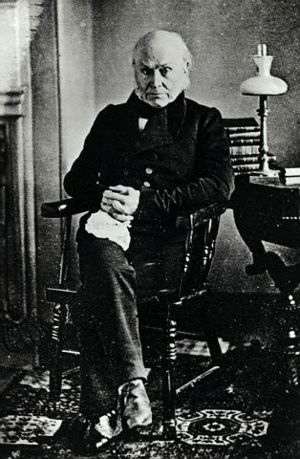
  • I think JQA’s greatest accomplishment may be that he became universally respected by his peers in that sort of “old dude is crazy, but he knows his stuff and is not someone to cross” kinda way.   His time as a sage crotchety old gruff and disagreeable congressman wearing the hat of “I don’t care about the politics of it, I’m on the side of what’s right!” is great to think about.   One look at any photo of him during his later years brings this thought easily to mind:  http://www.wikitree.com/photo.php/thumb/9/95/John_Q_Adams_1843_Photo.jpg/300px-John_Q_Adams_1843_Photo.jpg
  • There was a “Gag Rule” (http://tinyurl.com/Gagrule) in place preventing any petitions regarding slavery from being addressed by Congress.   JQA was the chief opponent of it.  Our country was on some shakey ground in its first century wasn't it?  Wow.
  • John Quincy A. made this statement, a poetic version of our Founding Fathers stance on participation in conflicts outside of U.S. borders or not directly involving the U.S.A, about the U. States which certainly makes one think how things have changed over the past 200 years:   “She is the well-wisher to freedom and independence of all.  She is the champion and vindicator only of her own.”      

Interestingly, probably only to me, I did NOT learn whether the writer was a male or female…not that it matters, but I did assume it would be easy to determine Parsons gender with a quick Google search, which it was not, marking the very first time I have ever found any justification whatsoever for an author to have his or her photo published – I only cared so I could write the first paragraph of this post using “his or her” when referring to the writer.   Despite that I couldn’t, I remain opposed to the idea of authors putting pictures of themselves on their books simply because from a marketing standpoint it seems counterproductive.  Speaking of photos; I have now gone back and added a picture for each Commander in Chief with each post and will continue to do so through the remainder of my quest.   Seems the office is not exactly a beauty contest.

Wednesday, August 24, 2011

The Last Founding Father: James Monroe and a Nations's Call to Greatness by Harlow Giles Unger


The best book so far.  I finished the book and couldn’t stop thinking about how under-appreciated James Monroe is.  He was indeed a great President and contributor to our history, but the book probably significantly helped me to come away with that belief.   Was it objective?  Nope.  Did it bother me that it wasn’t?  No, actually it didn’t at all…Unger made a hero out of Monroe, but there was enough there for it to be perfectly plausible that he was great in nearly every way, that I just enjoyed it.  The writing was solid, flowed well and resulted in a very fast entertaining read, especially for a biography.   I could go on, but I’d just be rephrasing the above words of praise for the book.  [Note:  If you have something against James Monroe then the book may infuriate you, but who has anything against James Monroe?  He rang in the “Era of Good Feelings!”]  OK, so, yeah, I also learned a ton reading the book…here are a few of those things:
  • He was shot in the shoulder during the Revolutionary War.  Unfortunately for him he was shot 141 years too soon (1776) to receive a Purple Heart, the coolest award that no one in their right mind ever wants to receive.  
  • Grew up friends with John Marshall, who basically created the judicial branch of our government, and remained friends with him throughout their lives even though they differed from time to time on policies etc.
  • Held 2 cabinet positions at the same time – Secretary of War and Secretary of State
  • Ran unopposed for the Presidency, twice!  (Well, basically…the first election he did have an opponent, but I think Mondale/Ferraro were closer to winning than his opposition)
    • He was one Electoral College vote away from being reelected unanimously for his second term.  It is said that the lone vote was cast for John Quincy Adams just so that George Washington would remain the only President elected by unanimous decision.  
  • All of South America owes him for the Monroe Doctrine…and so do U.S. West coasters.
  • Monrovia, Liberia is named after him.
  • The first wedding in the White House united two cousins in marriage.  (Maria Hester Monroe and her cousin Samuel Gouvereur)
  • George Washington gave him a letter of recommendation that Monroe hoped would help him become a Captain in the Continental Army, it didn’t, but James ended up using it to advance his political career.
  • James Monroe actually made the Louisiana Purchase deal – Jefferson gets credit as the President who ultimately authorized it, Madison gets credit as the Secretary of State who also authorized it and may have proposed it, but Monroe actually made the deal while overseas as our Minister to France, so he did the actual negotiation, which earns him the most credit for the fantastic bargain, if not any commissions.
  • After being elected President Monroe went on a tour of the country that would be exhausting even today in a Honda Odyssey with every possible amenity and 38 cup holders, in an effort to unify the people.  It worked as he was beloved by nearly everyone.  (Are you questioning the objectivity of the writer yet?  Count me convinced, he’s my new Favorite Founding father, after THE Founding Father {George Washington}, of course.)
  • James Monroe Died on July 4, 1831.   Are you kidding me?!   3 of the first 5?!!  And GW died on Case’s birthday!  Madison (June 28, 1836) couldn’t hold out 6 more days?  Or 5 months and 16 days?  Man…I am not impressed Mr. Madison.
OK, sorry for length of this one, but to me it is fitting since it was my favorite book thus far (plus these will get longer if I ever get caught up to the book I’ve just finished…still half a year or so behind, so be prepared).   John Quincy Adams coming soon…

Friday, August 19, 2011

The Great Little Madison by Jean Fritz


The first snag!   Accomplishing completion of book #4 proved to be a bit more difficult than 1-3...I bought "James Madison" by Ralph Ketcham and made it through 148 pages.   Those pages took me maybe half a year to read.   I seriously questioned whether I would ever finish the project....I still question it, but at least a little less than at that point.   I actually liked the book and there is no doubting that Ketcham did an exhaustive research effort before writing it...it's just that it was like eating tasty corn bread after leaving an all you can Tuesday night at Waffle House.   6 pages into the book and I had read more about the Madison family PRE-James than I have read about any family ever.   It was quite an amazing family, having spawned 2 U.S. Presidents (#4 and his second cousin, #12, Zachary Taylor), but that turned out to be indicative of the rest of the completely thorough review of James Madison's life.   I wouldn't say that it was boring, because it wasn't, it was just more than I was apparently looking for...so, I called an audible (and I do hope to finish the book someday, ya know, cus I ain't no quitter, and it was written pretty well, but as it threatened to derail the entire project I felt it best to move on) and found another James Madison book...well, that one turned out to be a 20 page kids level book, which would have made me upset with my Kindle, except that since it was only 99 cents I realized that I should've probably known something was up....SO, then I bought another James Madison book -- seems I spend money like our Founding Fathers, but anyway, this one was finally what I would consider good enough.   "The Great Little Madison" was only a few hundred pages long and kind of painted with a big brush, but having endured the 148 super detailed Ketcham pages and the wiki-plus sub-$1 attempt to satisfy "book #4 requirement" I was pleased with it.  Ralph Ketcham's book haunts me as it sits on the bookshelf, being nearly 800 pages long and therefore more visible than most, but I'll get to it someday so I guess I won't throw it on the fire...yet.   OK, so, let's just skip straight to the bullet points from here...The James Madison book list of things stupid Bobby learned:

  • James Madison seriously wrote the Constitution of the United States of America.   I guess I figured it was maybe 50 people or something, and in a way I guess you could say it was even more than that, but he seriously wrote the thing.  It is amazing and I give him full credit.  
    • He apparently studied all known attempts at formulation and experience of governments throughout the history of the world and used that incredible base to help achieve the tremendous accomplishment.   He then, being a scribe like perhaps no other person in public service before him, proceeded to team with Alexander Hamilton and John Jay to explain The Constitution to the people and defend it expertly through the press.  Their efforts are called "The Federalist Papers" and I feel like I should probably stop the project and read them in their entirety before moving on, but, well, that's not gunna happen.  As a result of his efforts in writing The Constitution, explaining it in writing and defending it through his life, he was, well, the greatest defender of it in the country's history.   This fact makes me think that he'd probably be the best U.S. citizen to bring back to life if we ever had that power, but I'd probably still choose Len Bias (1963-1986) or Tiger Woods (1975-2009).
  • Madison regularly made himself ill foregoing sleep and general health maintenance just to study/read/write.
  • Aaron Burr introduced Madison to Dolly, who became Dolly Madison the hardest partying 1st lady in history (to that point she unquestionably was, I'll let you know if she loses the title).
  • The Alien and Sedition Acts...just read about them, bizarre.  We really could've been like all the countries we think are insane.
  • During his Presidency his two VP's died while in office.   Remind me not to mess with James Madison if I ever travel back in time.   
  • The War of 1812 really was pretty questionable.
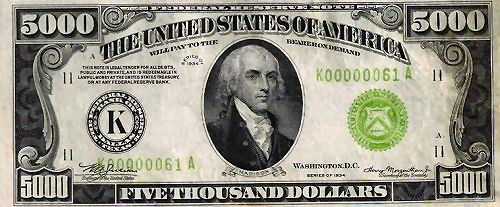
  • Madison is on the $5000 bill.  I've never seen a $5000 bill.   I'd like to.   It would look like this:  http://www.marshu.com/articles/images-website/articles/presidents-on-us-paper-money/five-thousand-5000-dollar-bill.jpg  (I actually didn't learn this from the book, but since I'm now interested in Presidents I seem to learn all kinda stuff about them just through everyday life....Madison Square Garden for instance, named after good ol' quatro!)
And I march on to Mr. Monroe...

Thursday, August 18, 2011

American Sphinx: The Character of Thomas Jefferson by Joseph J. Ellis


Believe it or not I actually purchased and read this entire book before realizing that it was written by the same guy who wrote the George Washington book I liked.  Not surprisingly then, I liked this book as well -- Ellis seemed to go out of his way to be objective, to the point of thoroughly presenting both sides of controversial viewpoints in regard to Mr. Jefferson, the 3rd President of the U.S. of A.   Yes, I was surprised that there were varying viewpoints on Thomas Jefferson as a whole, but we'll get into that in a bit...gotta stay on task here, reviewing the book.   The writing was detailed without being overdone and I believe the authors apparent goal, to outline and explain the former Presidents character, was accomplished...I definitely felt that I had been given insight towards him as a man, more-so than having been given a framework of his life accomplishments, of which there are, of course, many.  At times I did feel like JJ Ellis may have bordered on attacking his character actually, but as biographies tend towards the flowery and apologetic in relation to the subject I welcomed the counter points and he did also write of the positive as well, which again points to the objectivity of the book.   The length of the book was close to if not perfectly ideal.   Alright, now, to what I learned:

  • The Declaration of Independence that he is credited for writing, was not exactly written from scratch.  It was more a reorganization of previously written documents (1689 English rights document and the Constitution of Virginia, etc. etc.), with a distinct unification of sentiment angle -- he deserves great credit for the effort, no doubt, but I guess I always though he just sat down one day and wrote it from his own thoughts and viola, it was what some consider the greatest document ever created.  I realize now that my thoughts were incredibly unrealistic, but then, I never really thought about it.
    • States had their own Constitutions.
    • The topic/issue of slavery was discussed during the framing of the Declaration of Independence and purposely side stepped...this completely shocked me as I didn't think it was on anyone's radar until Lincoln decided slavery just wasn't right -- yes, I am that ignorant, or rather I was.  
  • Jefferson was not a good money manager.  He didn't seem to understand the concept of spending only what he actually had.
  • Alexander Hamilton was quite a figure in history...if I ever finish this project I'd really like to read a biography or 2 about him.   Jefferson didn't like him at all, but I guess probably liked him more than his VP, Aaron Burr, did.  
  • Thomas Jefferson commissioned the very cool and very bold Lewis and Clark Expedition...I had no idea at all when L & C went on their journey nor any of the reasons they did, prior to reading this book anyway.
  • The Louisiana Purchase was completed during TJ's presidency.
    • It did not include the Southwest...my head was seriously spinning learning that as I really did think it was everything west of the Mississippi.   I did very well in every history class I took too, seriously, I did.
  • The Secretary of State is in charge of foreign policy.  I find it amazing that I enjoyed as many Ludlum, Flynn, Clancy etc. books and similarly themed movies as I did without being aware of that.   It was also a monstrously important political position in the first era of our country having been a pathway to the Presidency for Jefferson and then 4 other of the first 9 Presidents.  (I'll let you know when I think an "era" begins and ends in relation to our country...right now I'm thinking Pre-Civil War is Era 1, but I may amend that as I learn more)
  • Party related "politics" have been a part of our history since George Washington left public service.
  • Thomas was portrayed convincingly as a conniving, manipulative person who, while being perhaps naively and inspiringly optimistic about the country and its people's lot in life, was basically dishonest in some instances.   For this reason I do not think that the typical UVA graduate would appreciate this book very much.
  • I want to visit Monticello.
  • The French Revolution was literally RIGHT AFTER ours.
  • Jefferson's mentoring type relationship with Madison and Monroe was pretty incredible.
  • He died on the same day, the 50th anniversary of July 4th 1776, as John Adams, his friend/peer/enemy/friend/peer/enemy/friend.

OK, I'm pretty sure I learned more than just those points actually, as again Ellis seemed to write in a style that I found easy to read, but it's been a while since I finished the book, so I have probably now forgotten everything else I learned...I might have to do this project again...I was eager to read about James Madison next though...and with that, I'll end this post.